Blue Moon and Micromoon to Coincide on 30–31 May 2026: What It Means and How to Watch from India

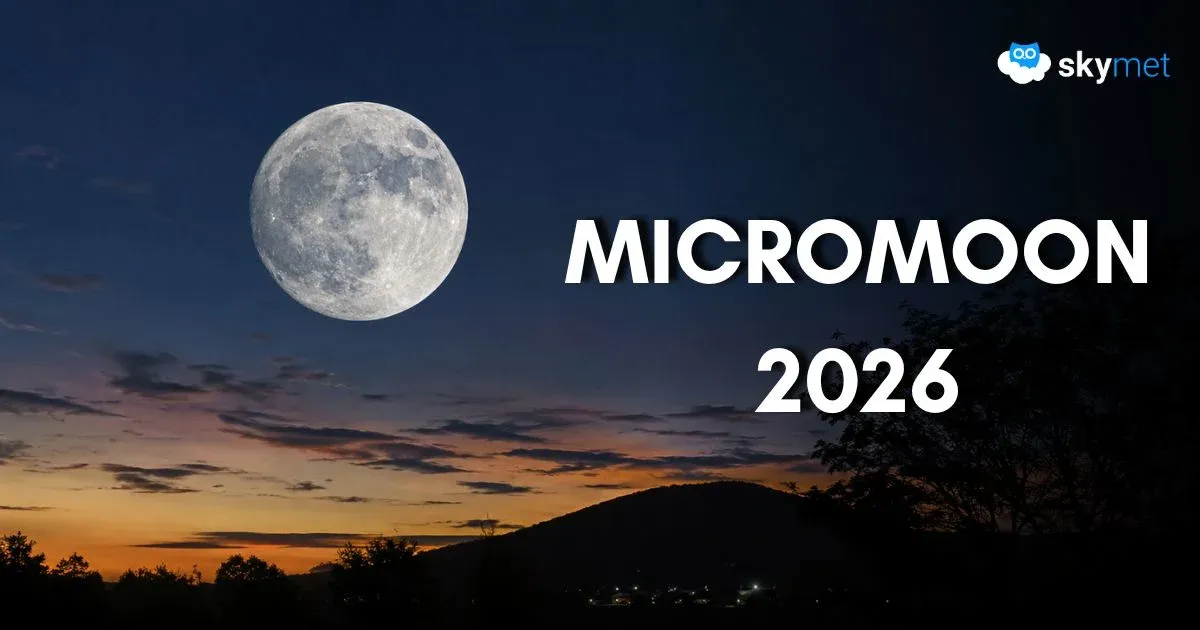
Representational Image: AI-Skymet
Key Takeaways:
- The full moon of 30–31 May 2026 is both a Blue Moon and a Micromoon.
- A Blue Moon is the second full moon occurring within a calendar month.
- A Micromoon occurs when the full moon is near apogee, its farthest point from Earth.
- The best viewing opportunity in India is the evening of 30 May after sunset.
A full moon that is both a Blue Moon and a Micromoon will rise on 30–31 May 2026, offering skywatchers a rare celestial pairing. While the moon will neither appear blue nor dramatically smaller than usual, the science behind this combination makes it an intriguing event for astronomy enthusiasts.
This weekend, the night sky has something unusual on offer. The full moon rising on the evening of 30 May carries a rare double tag—it is simultaneously a Blue Moon and a Micromoon. The moon will not actually appear blue, and it will not look dramatically tiny. However, the science behind why this pairing is uncommon is genuinely fascinating.
What Is a Blue Moon?
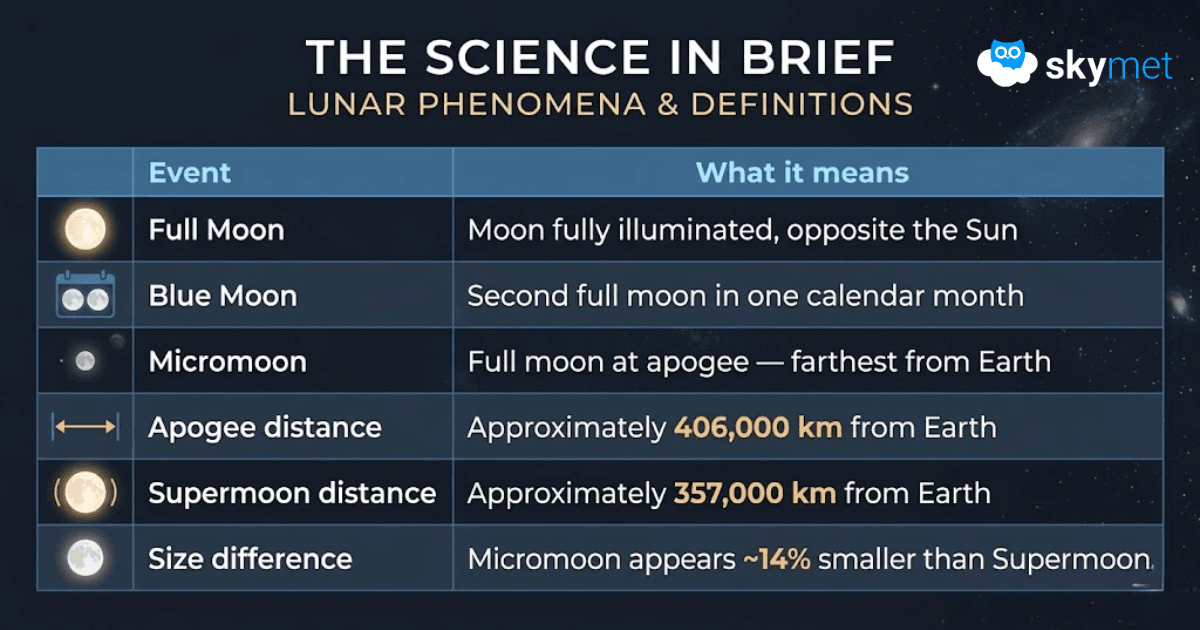
Despite the phrase "once in a blue moon," this event is not as rare as it sounds. A Blue Moon simply refers to the second full moon occurring within the same calendar month. May 2026 had its first full moon earlier in the month, and this weekend's full moon is the second, making it a Blue Moon under the most widely used modern definition.
The term has nothing to do with colour. It likely evolved from older English expressions describing something unusual or improbable. The moon will only appear bluish under very rare atmospheric conditions, such as volcanic ash or wildfire smoke scattering red light, which is not expected this weekend.
Blue Moons occur roughly once every two to three years because the lunar cycle of approximately 29.5 days does not divide evenly into calendar months.
What Is a Micromoon?
The moon follows an elliptical orbit around Earth rather than a perfect circular path. As a result, its distance from Earth changes throughout the month.
A Micromoon occurs when a full moon coincides with apogee—the point in the moon's orbit where it is farthest from Earth. During this event, the moon appears roughly 10–14% smaller and slightly dimmer than a Supermoon.
Most casual observers are unlikely to notice the size difference with the naked eye, but photographers comparing images with those of a Supermoon can detect the contrast more easily.
The opposite phenomenon—a full moon occurring near perigee, the moon's closest point to Earth—is known as a Supermoon. The next Supermoon is expected on 24 December 2026.
Why Does This Matter for Skywatchers?
The peak illumination of this full moon occurs at 8:45 AM UTC on 31 May, which corresponds to 2:15 PM IST. Since this occurs during daylight hours in India, the best viewing opportunity will be on the night of 30 May when the moon rises in the eastern sky shortly after sunset.
No telescope is required. Simply step outside after 8 PM and look toward the eastern horizon to spot the full moon. Binoculars can enhance the experience by revealing craters and the dark volcanic plains on the lunar surface, known as maria.
Weather conditions may influence visibility. The clearest views are expected across western and northwestern India, including Rajasthan, Gujarat and parts of Madhya Pradesh, where skies are likely to remain relatively dry. Meanwhile, cloud cover associated with active pre-monsoon weather may affect viewing conditions over Northeast India, West Bengal, Kerala and the Andaman Islands.
One More Thing
The coincidence of a Blue Moon and a Micromoon is not controlled by any single astronomical cycle. It occurs only when the lunar orbit, the lunar calendar and the Gregorian calendar align in a specific way. That makes this weekend's event a genuinely uncommon pairing, even though neither a Blue Moon nor a Micromoon is exceptionally rare on its own.
Set a reminder for sunset on 30 May, look toward the eastern sky, and enjoy one of the more interesting lunar events of 2026.