Why Mild April Summer So Far Over North India?

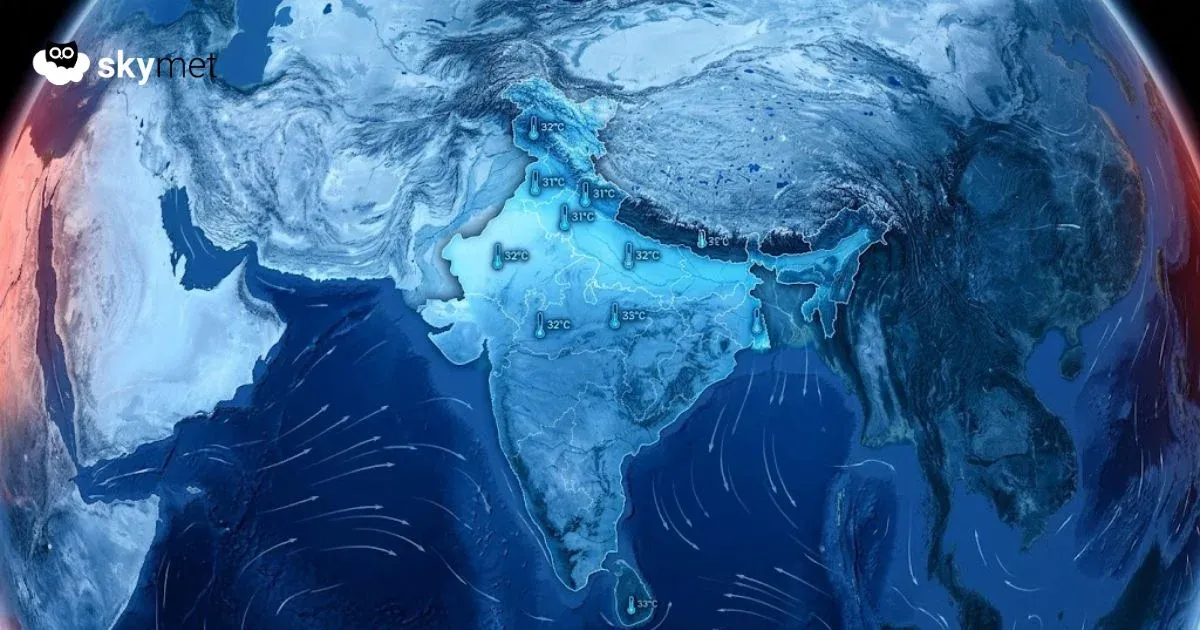
Representational Image: AI-Skymet
Key Takeaways:
- North India continues to experience unusually mild April conditions
- Frequent Western Disturbances and rainfall kept temperatures suppressed
- Heat will rise gradually but no extreme spike expected
- Heatwave conditions likely to remain absent this April
Plains of North India have been enjoying pleasant weather conditions so far. April heat seems to be a misnomer. Day temperatures over Punjab have remained in the low 30s, and adjoining Haryana and Rajasthan have also witnessed mercury levels under 35°C over a large area. Minimum temperatures have stayed at or below 15°C at many places. The seasonal heat is yet to catch up with the typical summer over the northern plains.
There are multiple factors responsible for the continuation of relatively cool weather conditions. There has been a trail of Western Disturbances moving in quick succession across the mountains. A couple of these had induced cyclonic circulations over the plains. Together, these systems unleashed widespread rain and thundershower activity during the first ten days of the month. Northwest India had an excess of 158% rainfall for the week between 2nd and 8th April 2026. Fresh snow and rains over the mountains had a cascading effect, suppressing mercury levels in the plains.
The plains have observed very strong northwesterly winds in the lower levels. This becomes a normal feature in the wake of transiting systems across the mountains. Speedy winds down the slopes of the mountains kept the heat factor under check and resulted in an appreciable fall in night temperatures. Courtesy of these winds and rains, the cosy winter flavour had an extended stay across the plains of North India.
The desert areas across the borders have also stayed cool and calm. Central and southern parts of Pakistan have witnessed sheltered heat so far across the entire region. Notorious places like Jacobabad and Rohri have not exceeded 38°C so far. Southeastern parts of Pakistan, covering Nawabshah, Padidan, Chhor and Hyderabad (Pakistan), which invariably cross 45°C by mid-April, have barely reached the 40°C mark in the last couple of days. Otherwise, westerly winds transport this heat from across the border to Rajasthan, Punjab and Haryana.
Now, there is no active Western Disturbance expected to affect the plains of North India. Heat is likely to increase over parts of Pakistan as well. With prevailing winds, this will get advected over the Indian region during the next few days. However, Western Disturbances moving across the mountains will restrict any abrupt rise in temperature over the northern plains. Despite rising mercury levels over North India in the next one week, extreme heat is unlikely to set in. Therefore, heatwave conditions, which invariably occur for a few days in April, may miss the mark this season.