Back To Back Western Disturbances: Rainfall-Snowfall over Mountains

Key Takeaways:
- February sees frequent but short-lived western disturbances
- Two systems to affect North India in quick succession
- Hills to receive rain and snow, plains to see limited impact
- A prolonged dry spell expected after mid-February
The frequency of western disturbances is higher in the month of February. However, the duration and time spent by these systems are shorter. Clearance of weather activity becomes faster over the mountains. The track of western disturbances also shifts to lower latitudes, allowing the northern plains—especially the foothills—to receive a higher number of wet spells. The westerly jet, with speeds in excess of 200 kmph, occurs as a regular feature and occasionally triggers weather activity as well.
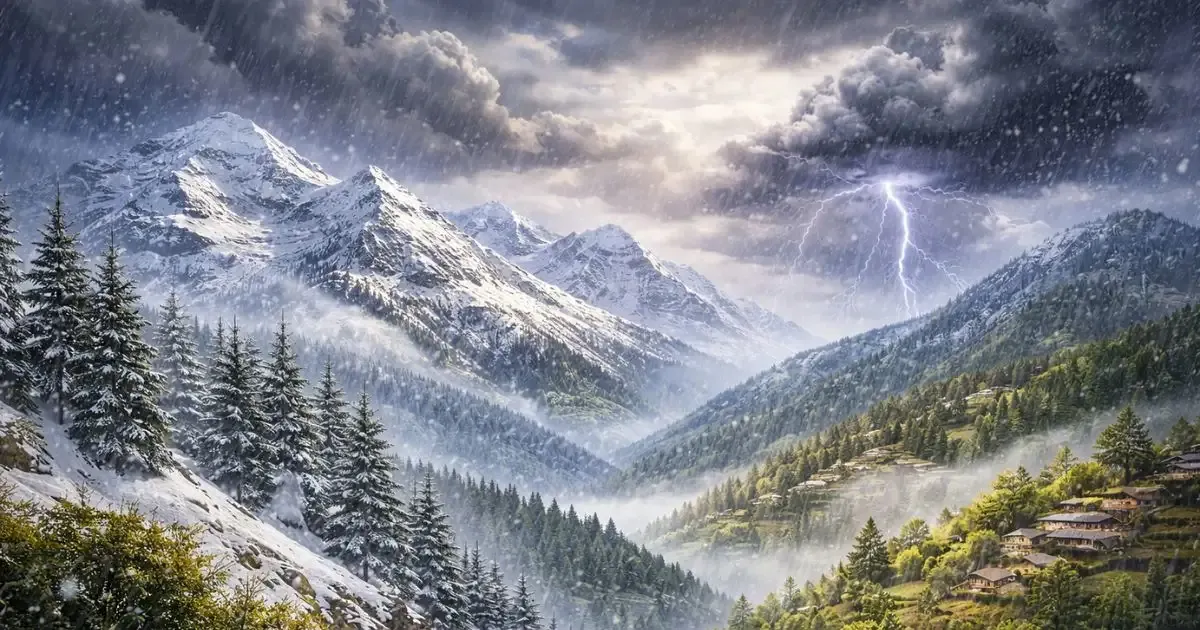
A pair of western disturbances is likely to move across the northern mountains in quick succession. However, the weather activity will remain mild to moderate over the hills, and broad services are unlikely to be impacted. The plains will largely be spared from any significant weather activity, though these systems will trigger changes in temperatures, winds, and a few light and fleeting showers.
The first western disturbance will arrive on the night of 5 February 2026. It will not be supported by any secondary system over the plains. Weather activity will remain confined to the higher reaches on 5 February and will cover most parts of Jammu & Kashmir, Ladakh, and Himachal Pradesh on 6 February. The spread and intensity will not be large, and the least activity is expected over Uttarakhand. Even the foothills of the hilly states may remain largely unaffected, with conditions limited to cloudy skies. Broad clearance is expected from 7 February across the entire region.
The second western disturbance will arrive on the night of 8 February 2026 and is expected to be relatively stronger. An induced cyclonic circulation will also develop over the plains. Together, these systems will complement each other and enhance the extent and scale of weather activity. The mountains will receive rain and snow on 9 and 10 February 2026, with remnant effects lingering on 11 February, confined to higher altitudes. Jammu & Kashmir and Himachal Pradesh will be the primary beneficiaries, while Uttarakhand will receive limited activity.
Weather activity will extend to parts of Punjab and Haryana on 9 and 10 February 2026. The peripheral influence of the system will affect parts of northeast Rajasthan, southwest Uttar Pradesh, north Madhya Pradesh, and the Delhi region. The activity will remain patchy, with brief spells of light rain. Broad clearance over the plains is expected later on 11 February 2026. Thereafter, both the mountains and plains are likely to experience a prolonged break in weather activity until 20 February 2026.