February 2026: Planet Parade and Ring of Fire Eclipse Captivate the Skies

Key Takeaways:
- Annular “ring of fire” solar eclipse will occur on February 17, 2026, mainly visible from Antarctica.
- A six-planet parade will peak around February 28, 2026 after sunset.
- Planetary alignments are visual perspective effects, not physical clustering.
- These celestial events do not affect Earth’s weather but are scientifically significant.
February 2026 offers skywatchers a stunning double bill: a six-planet parade peaking around February 28 and an annular solar eclipse on February 17, reminding us how dynamic our solar system appears from Earth.
What is a Solar Eclipse?
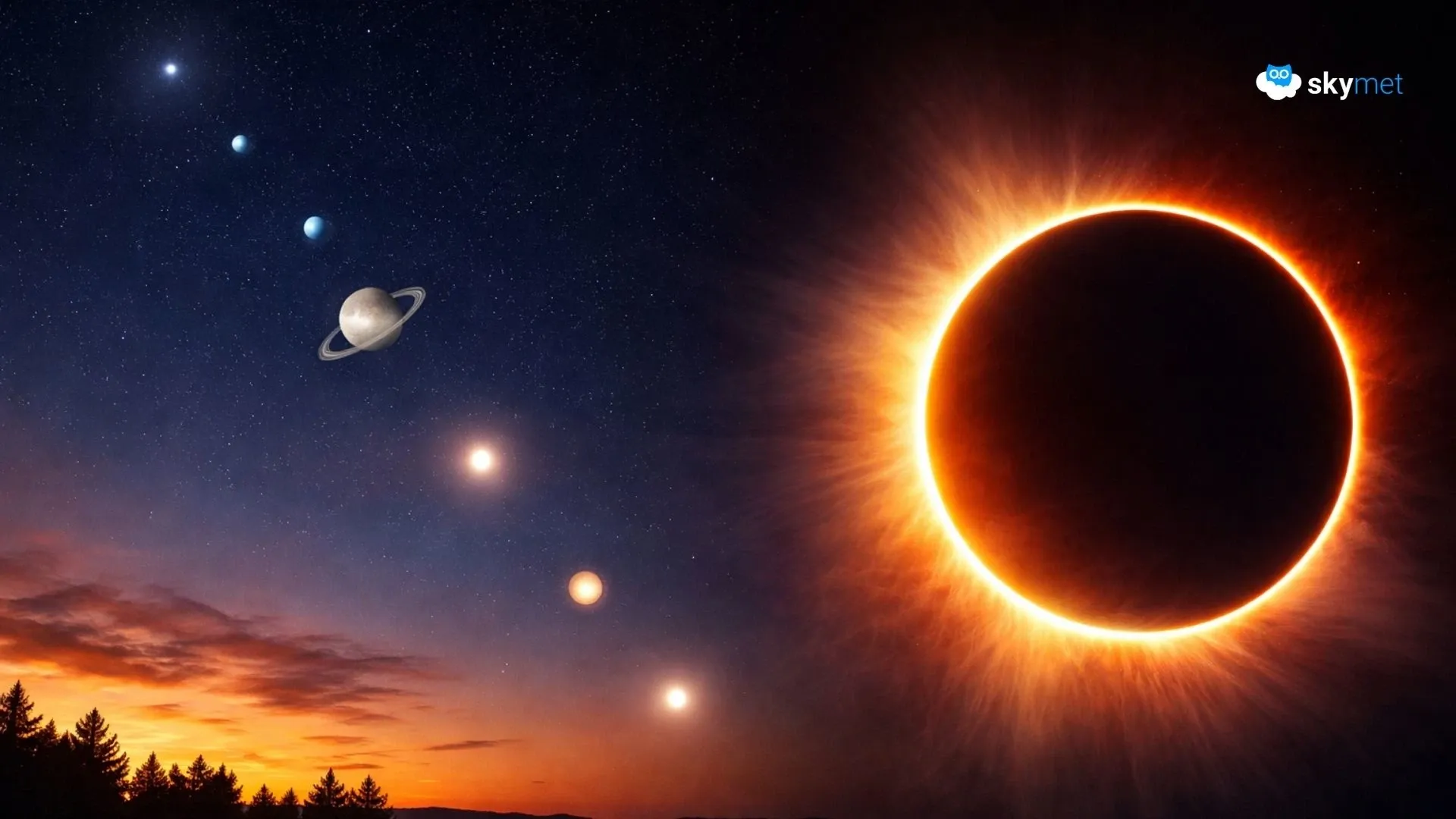
A solar eclipse occurs when the Moon passes between Earth and the Sun. On February 17, 2026, this cosmic alignment will produce an annular eclipse, often called a “ring of fire,” in which the Moon appears slightly too small to cover the Sun completely, leaving a bright ring around its dark silhouette.
Because the Moon will be near the farthest point in its orbit, this ring will be visible along a narrow track across Antarctica, with a partial eclipse visible in parts of southern South America and southern Africa.
What is a Planet Parade?
A planet parade is an optical alignment in which multiple planets appear clustered in the same region of the sky from Earth’s perspective. In February 2026, Venus, Mercury, Saturn, Neptune, Uranus, and Jupiter will be visible after sunset.
This is not a true gravitational clustering but a perspective effect caused by planetary orbits. Bright planets such as Venus and Jupiter are visible to the naked eye when positioned high enough in clear skies, while faint planets like Neptune require binoculars. Low horizon positions and twilight glare often hide dimmer worlds.
When Will These Occur?
Beginning February 8, Venus and Mercury rise near Saturn in the west-southwest, while Jupiter shines in the southeastern sky. Neptune and Uranus appear nearby toward mid- to late February, with Mercury reaching its highest evening visibility on February 20 and the full six-planet lineup best viewed around February 28.
These events highlight celestial mechanics—planets orbiting the Sun at different speeds occasionally form rare visual lineups that have inspired astronomy from ancient skywatching to modern orbital science.
Eclipses arise from the precise geometry of the Sun–Earth–Moon system, helping scientists refine measurements of orbital motion and distance. Planetary parades demonstrate how gravity-driven planetary motion can create striking alignments in Earth’s sky.
While these alignments have no direct influence on Earth’s weather, they deepen public curiosity about space and strengthen scientific understanding of our place in the solar system.